
Criminal Court Cases in Tazewell County
The Tazewell County Courthouse is the local trial-court hub. The Circuit Court of the Tenth Judicial Circuit is a court of general jurisdiction, so felony and misdemeanor prosecutions both move through the circuit system. County directory details associate Courtroom 101 with felony matters, Courtroom 104 with criminal matters, and Courtroom 207 with traffic matters. Municipal ordinance cases also use the circuit-court structure. Illinois does not add a separate local trial-court layer for each municipality.
The Circuit Clerk is the custodian of filed criminal case records. Its file begins when a complaint, information, or indictment is lodged with the court. It then gathers the docket, counts, hearing settings, motions, orders, judgment, sentence, and financial entries. A police report remains with the agency that wrote it. A jail record remains with the sheriff. Those sources may explain an arrest, but neither replaces the Tazewell County court file.
Tazewell Circuit Clerk Record Gateway
The Tazewell Circuit Clerk site is the official gateway for online records, forms, fees, and clerk services. Start there instead of assuming that a broad statewide name tool includes every local file. Illinois has no single, complete, free statewide trial-court name search. Vendor screens and filter labels can change, so the clerk gateway is also the right place to confirm the current path into the record system.
The official clerk gateway shows how local services are organized.
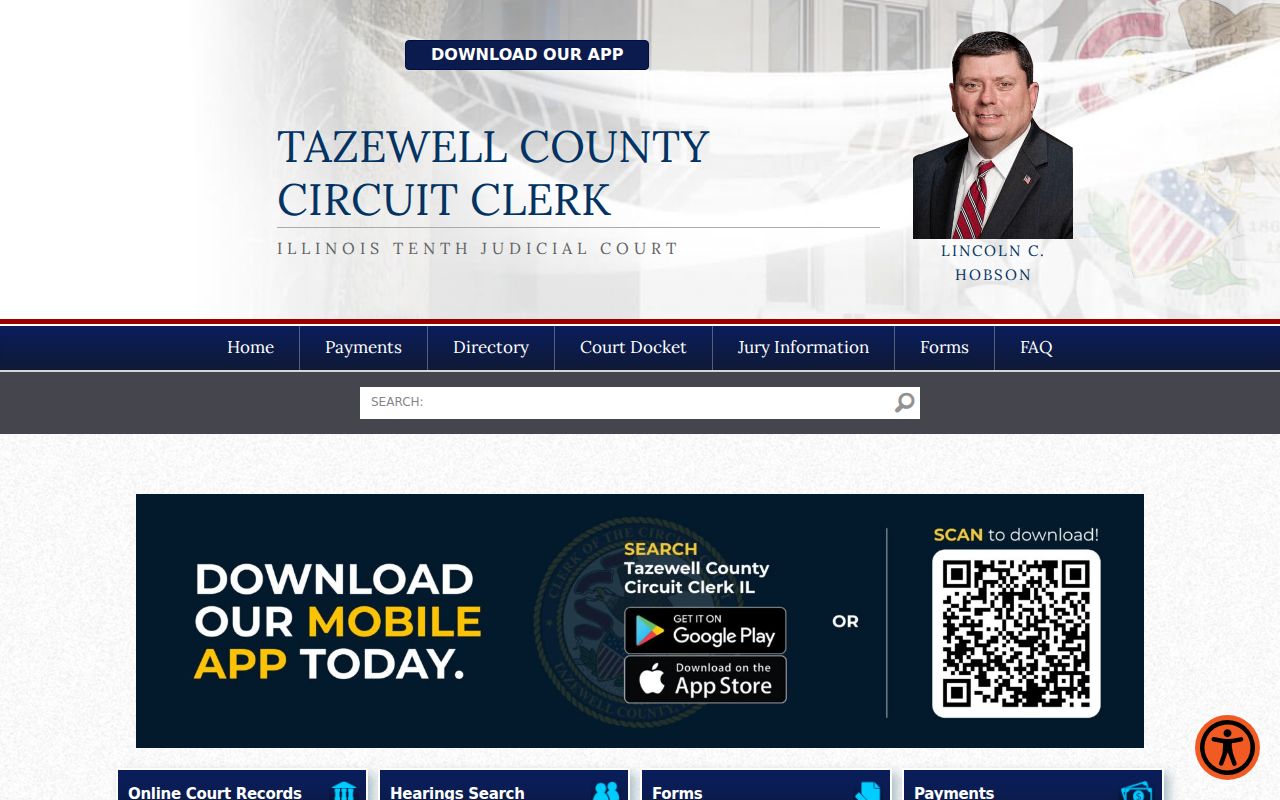
Use that source to reach the current Tazewell County search rather than a copied vendor link that may expire. If the screen does not produce a match, call the Criminal Division at 309-477-2775. Ask staff whether the case is online, at the counter, archived, sealed, or held in another format.
Note: A search screen is an index and information tool; only the Circuit Clerk can issue a certified Tazewell County court record.
Tazewell County Case Record Searches
Use the exact case number when possible. Illinois case numbers commonly include the filing year, a case-type code, and a sequence. A name search can find a starting set, but spelling, aliases, and old indexing practices can broaden or hide results. Common criminal categories may include CF for felony and CM for misdemeanor, with MT or TR for traffic-related matters. Treat the live portal as the authority for its current labels.
- Open the Circuit Clerk gateway and follow its current online-records link.
- Enter the Tazewell County case number, or start with an exact defendant surname and given name.
- Narrow the result by filing year, criminal case type, and Tazewell County court location when those filters appear.
- Open the docket and read count-level entries, dates, and status instead of relying on one charge line.
- Contact the Criminal Division for filed documents, a complete disposition, or a certified copy.
| Field Label | Type | Required | Use |
|---|---|---|---|
| Case number | Text | Alternative | Most precise key; often includes year, type, and sequence |
| Party or defendant name | Text | Alternative | Begin with exact surname, then try documented variants |
| Filing year or type | Filter | No | May narrow CF, CM, MT, or TR records |
| Court or location | Filter | No | Select Tazewell County or Tenth Circuit when offered |
| Search or Reset | Button | Not applicable | Exact interface labels depend on the current vendor |
Older Tazewell County Criminal Files
A missing online result may be an access issue, not proof that no case exists. Older Tazewell County criminal court cases may be on microfilm, archived, indexed under a name variation, or unavailable through remote access. The county publishes a Microfilm Division number, 309-477-2217, for older material. Give staff the case number and year if known. Ask whether the file is onsite, microfilmed, archived, or restricted, and request the current copy and certification costs before ordering.
Remote access can be narrower than counter access under the Illinois Supreme Court Remote Access Policy. Some documents may not be displayed even when the public docket shows the case. Birth details, addresses, victim or minor information, confidential reports, sealed counts, and some documents can be omitted or redacted. A focused question to the clerk saves time and avoids treating a blank screen as a final answer.
What a Criminal Case File Contains
A Tazewell County case file is organized around the court's work, not the jail intake event. Check every count. One count may be dismissed while another ends in supervision, a guilty finding, or another result. Financial entries can combine assessments, restitution, and payments. A balance alone does not prove guilt, and a zero balance does not prove dismissal.
| Case identity | Case number, caption, filing date, case type, status, judge, and courtroom |
|---|---|
| Formal counts | Charge description, cited statute, class, complaint, information, or indictment |
| Docket | Chronological filings, motions, hearings, continuances, warrants, and orders |
| Participants | Parties and attorneys, subject to privacy and access limits |
| Outcome | Count-level disposition, written judgment, sentence, and supervision terms |
| Financial record | Assessments, restitution, payments, and balances without implying a result by themselves |
| Documents | Availability of filings or copies; remote view may not expose the full paper file |
Read Tazewell County Docket Terms
A docket is a dated list of court events. It is not a plain-language summary. “Information filed” means the prosecutor filed a charging instrument. An indictment is a grand jury accusation, not a guilty finding. An arraignment is the hearing where charges are stated and a plea is entered. A continuance moves a setting and does not resolve the case. Review the written judgment and each count rather than treating the last line as the whole result.
- Pending
- No final outcome has been entered for the case or count.
- Disposed
- The court has entered an outcome, which must still be read at count level.
- Nolle prosequi
- The prosecutor ended the charge without a conviction on that count at that time.
- Supervision
- An Illinois disposition that may avoid a judgment of conviction if completed successfully.
- Disposition
- The court's final result for a count or case.
Criminal Case Stages in Tazewell County
A local criminal matter can begin with an arrest or summons. The court addresses the initial appearance and pretrial release, while the State's Attorney decides which formal charges to file. A felony may proceed by information or grand jury indictment. Arraignment follows, then discovery, motions, and negotiated or contested proceedings. A plea or trial leads to judgment and, when applicable, sentencing. Post-judgment motions or an appeal may add later entries.
Case flow: Charges Filed › Arraignment › Pretrial › Plea or Trial › Disposition › Sentencing
Illinois pretrial rules changed through the Pretrial Fairness Act. Do not read old cash-bond assumptions into a new Tazewell County docket. A sheriff bonding instruction may still apply to certain payable warrants or financial transactions, but the court decides release and detention under current law.
Tazewell Court File Versus ISP
The Tazewell County circuit file and an Illinois State Police transcript answer different questions. The clerk file is the authoritative local chronology. It shows pleadings, court dates, rulings, written orders, disposition, and sentence. The ISP Bureau of Identification builds a statewide transcript around fingerprint-linked arrest cycles and court outcomes reported to the repository. Public conviction information and a person's fuller Access and Review product also have different dissemination rules.
When an outcome on a personal ISP transcript looks wrong, first obtain the certified Tazewell County disposition. If the clerk record is accurate, follow ISP Access and Review and Record Challenge instructions with the court proof. If the clerk entry itself is wrong, address the underlying court file first. The sheriff cannot amend a Circuit Clerk judgment, and the clerk cannot directly rewrite the ISP transcript.
Identifiers help keep that correction path clear. The circuit case number follows pleadings, hearings, and judgment. An ISP State Identification number and fingerprint transaction number belong to the repository process. A jail detainee ID points only to county intake. Write each number beside its source before contacting an office. That small step prevents a clerk request from being keyed to a jail number and helps ISP match certified Tazewell County court proof to the right arrest cycle.
Federal Cases Beyond Tazewell Court
Federal charges arising in Tazewell County do not become county Circuit Court files. They belong to the U.S. District Court for the Central District of Illinois and are searched through PACER. PACER requires registration, and its current fee and waiver terms should be checked before use. The federal court remains the official source even when a contributed copy appears elsewhere.
The district court's official site provides the federal venue and service context.
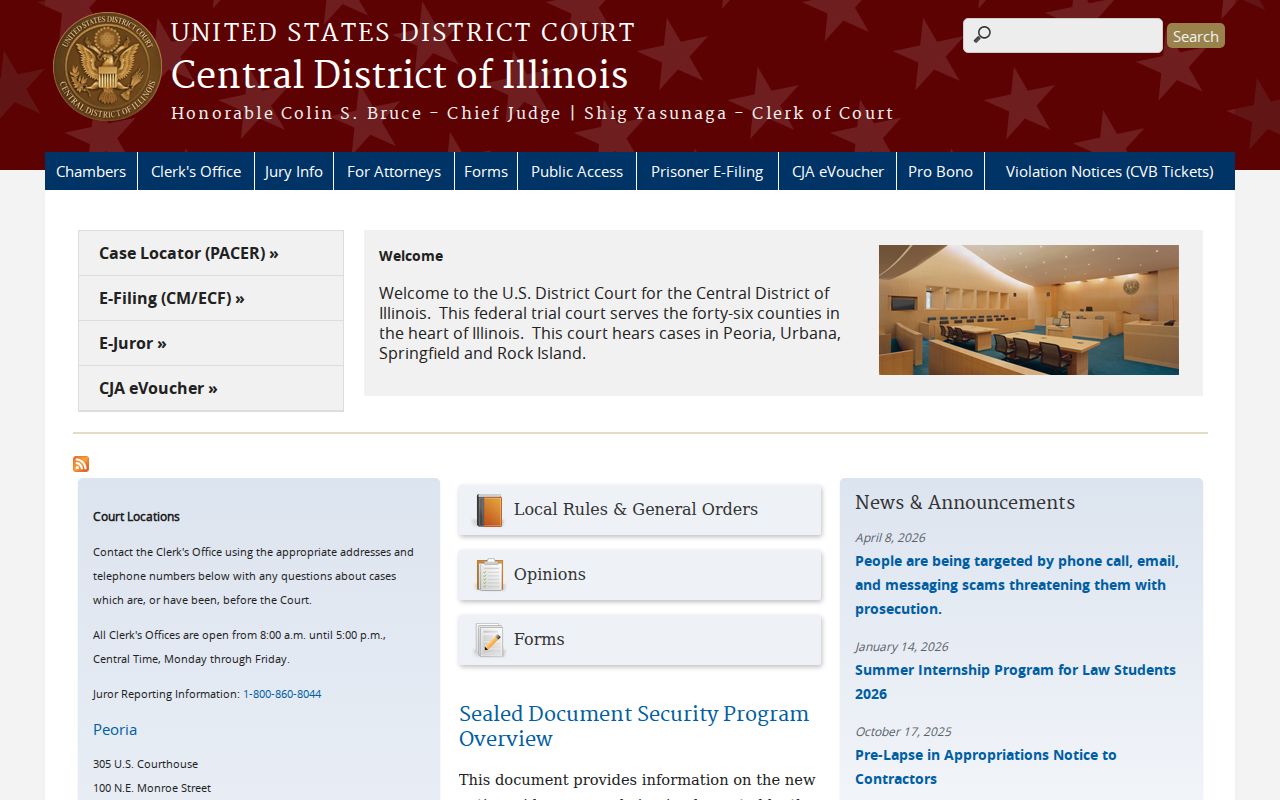
Keep federal custody separate too. The Bureau of Prisons locator does not list people held only at the Tazewell County jail or in Illinois state custody.
Access Rules for Case Records
Open access has limits. Juvenile cases, sealed matters, protected victim data, private identifiers, medical facts, and confidential reports may be withheld or redacted. The Illinois Freedom of Information Act governs agency records, but court access also follows judicial policies and court orders. FOIA does not force release of material made confidential by another law.
For a public Tazewell County criminal court file, ask the Circuit Clerk what is available online, at the counter, or by copy request. Certified dispositions come from the clerk, not from a screenshot. For the broader county process, the Tazewell County criminal history overview explains how clerk, police, sheriff, and ISP records connect without merging their separate meanings.
A focused copy request should name the case number, filing year, desired document, and whether certification is needed. Ask about the current charge before authorizing the order because the inspected sources did not establish a Tazewell County document-price schedule. For a final result, request the written judgment or count-level disposition rather than a bare docket print. That record is more useful when a person must correct a repository entry or document how several counts ended.
Note: Sealed or juvenile cases may be absent remotely even when an authorized office retains a restricted record.